
By Adam Stewart
Hutchinson Tribune Staff
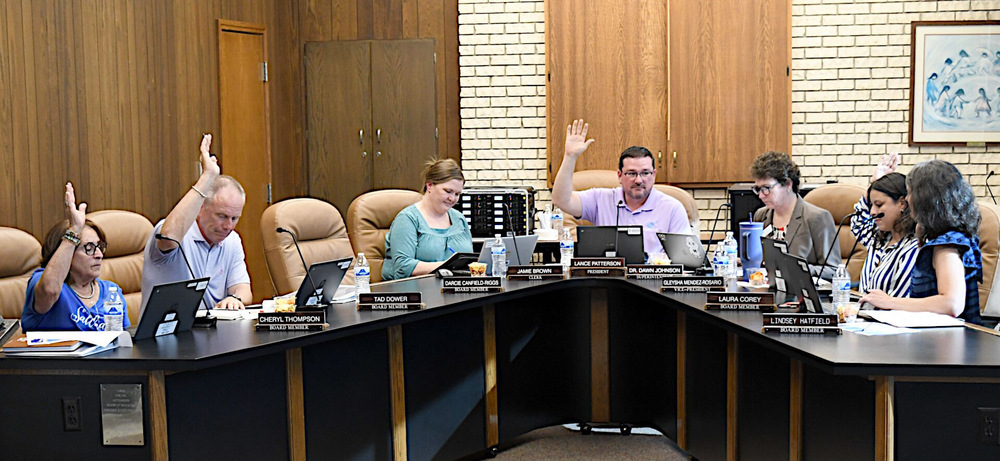
HUTCHINSON—Hutchinson elementary schools posted their best third-grade state English/language arts assessment scores of the past decade in 2025-26, the USD 308 Board of Education heard at its meeting on Monday, June 22.
Assistant Superintendent Krystal Young presented an overview of the assessment results. Over the past five years, the percentage of third graders below level on the assessment has consistently declined, from 55% in 2021-22 to 40% in 2025-26.
“That’s what we want to have happening,” Young said.
She said that the school board made improvement in third-grade reading, a goal of its strategic plan, and the work it has done on that—focusing on quality instruction, professional learning, and giving teachers what they need to succeed—has shown results. That has included having instructional coaches in every school and two years implementing Visible Learning training, as well as Science of Reading and LETRS training.
“We’re in the best place we’ve been in the last 10 years academically,” Young said. “And we want to continue to see that growth.”
Board Member Cheryl Thompson asked Young what she meant by that.
“Research would say if students can read, they’ll do better academically in all areas,” Young said, adding that the district is also seeing improvement in math assessment scores.
Additionally, kindergarten reading data from the district’s Fastbridge system showed 2025-26 with the highest percentage of students at low risk and the lowest percentage of students at high risk for reading trouble since the district started using that system in 2022-23.
“We want to continue to see the low risk go up and the high risk go down,” Young said.
And 10th-grade state English/language arts assessments continue to see an increase in students at or above grade level, from 51% in 2021-22 to 64% in 2025-26.
“This is meaningful,” Board Member Laura Corey said. “It definitely shows growth.”
Corey said she hoped the administration would be able to correlate what changes for students between kindergarten and third-grade assessments. Young said the 2025-26 third-graders were the first ones the district had kindergarten assessments for, so they can start to look at that now.
Board Member Tad Dower said that everything is harder when students aren’t able to read at the appropriate level, so he was pleased with the progress.
“I’m encouraged by all of this,” he said.
Board Member Gleysha Mendez-Rosario said that during the unsuccessful 2025 school bond campaign, a lot of people questioned the district’s academic results.
“This just proves we are moving in the right direction,” she said.
On the subject of school bonds, Superintendent Dawn Johnson told the board that she saw three main options. One would be for the board to put a 10-year, approximately $36 million bond on a ballot to address the district’s most pressing facilities needs, including roof and HVAC replacements, while using the district’s capital outlay levy to pay for less urgent needs over the same 10 years, as the board heard at its June 8 meeting. That would allow the district to make a combined $60 million in improvements and repairs without increasing the total mill levy when the district’s existing bond issue is paid off.
Another option, Johnson said, could be to ask voters to approve a bond issue for about $90 million to build a new combined sixth- through eighth-grade middle school, without the other facilities improvements that were proposed in the $109.5 million bond election in 2025. Johnson said that would still amount to a mill levy increase, despite a smaller price tag than the 2025 proposal.
Or, Johnson said, the district could do nothing with regard to a bond issue and pay off the existing bonds, lowering the district’s total mill levy. However, at the June 8 meeting, Finance Director Abby Stockebrand said that the district’s capital outlay authority would not be enough on its own to make needed repairs and maintenance to the district’s facilities.
Johnson said that in order to have a bond on the November ballot, the board would need to approve a resolution by Aug. 10. She said that if the board was interested in possibly putting the $36 million bond on a ballot, she would want to have a discussion with finance professionals at a July board meeting.
Mendez-Rosario said that she has met with some school district patrons, and the people she spoke with said they could get behind a smaller bond that resulted in no tax increase.
Thompson asked whether a bond election could be held in spring 2027. Johnson said it could, but if it was, the district’s tax levy would take a one-year dip before going back up, and the district could no longer say the proposal was for no increase.
Dower said that, after the last board meeting, he saw people posting on social media, saying that it’s the same issue as 2025 and questioning why the board would consider it again.
“This is not the same issue,” Dower said. “This is not the $109-, $110-million bond that we’re talking about. This is a different bond issue.”
Board President Lance Patterson said the 2025 bond proposal was an opportunity to meet all of the district’s facility needs for the next 25 years. With that off the table, the district’s needs didn’t change, and now the board needs to look at other ways to meet the needs.
“We’re going to have to do it differently,” he said. “Doing nothing is not an option. It’s just not.”
He said the board needs more specifics from finance professionals about the 10-year bond option, and he wanted to include board members Darcie Canfield-Riggs and Lindsey Hatfield, who were absent Monday, in the discussion.
Building trades project
Hutchinson Career and Technical Education Academy Director Travis Riebel gave an update on HCTEA’s 2025-26 building trades projects.
In partnership with Hutchinson Community College and Interfaith Housing and with support from a $708,965 Fostering Residential Advancement through Mentoring and Education grant, the partners built a duplex on East Avenue A and a single-family home on East 10th Avenue. Both are in finishing stages.
The college will market and sell the properties, with the proceeds rolling back into the program.
Each unit of the duplex is about 1,700 square feet, with a detached garage with alley access. Riebel said the duplex was designed to match the style of the Houston Whiteside Historic District, which it is located in, as well as possible.
Corey asked whether it was required to match the style or if that decision was made by choice. Riebel said it was required by the Hutchinson Landmarks Commission.
“But we don’t want our home to look out of place,” he added.
Riebel said a future building trades project could be the former St. Elizabeth’s Hospital site at 20th and Monroe. He said Interfaith Housing has a concept for the site that could include four single-family homes and four duplexes. But first the district would need an agreement with Interfaith Housing for the project, which Riebel said is a work in progress.
“I’m excited about that project,” Dower said. “It’s what Hutchinson needs.”
In other business, the board approved 19 policy updates recommended by the Kansas Association of School Boards to match changes in state law, continued discussion of the benefits of trimesters or semesters at Hutchinson High School, and met in closed executive session for 10 minutes to discuss labor negotiations and for 15 minutes to discuss a personnel matter. After the latter executive session, the board approved the personnel report.